Atlas.
Complex logic. A clearer picture.
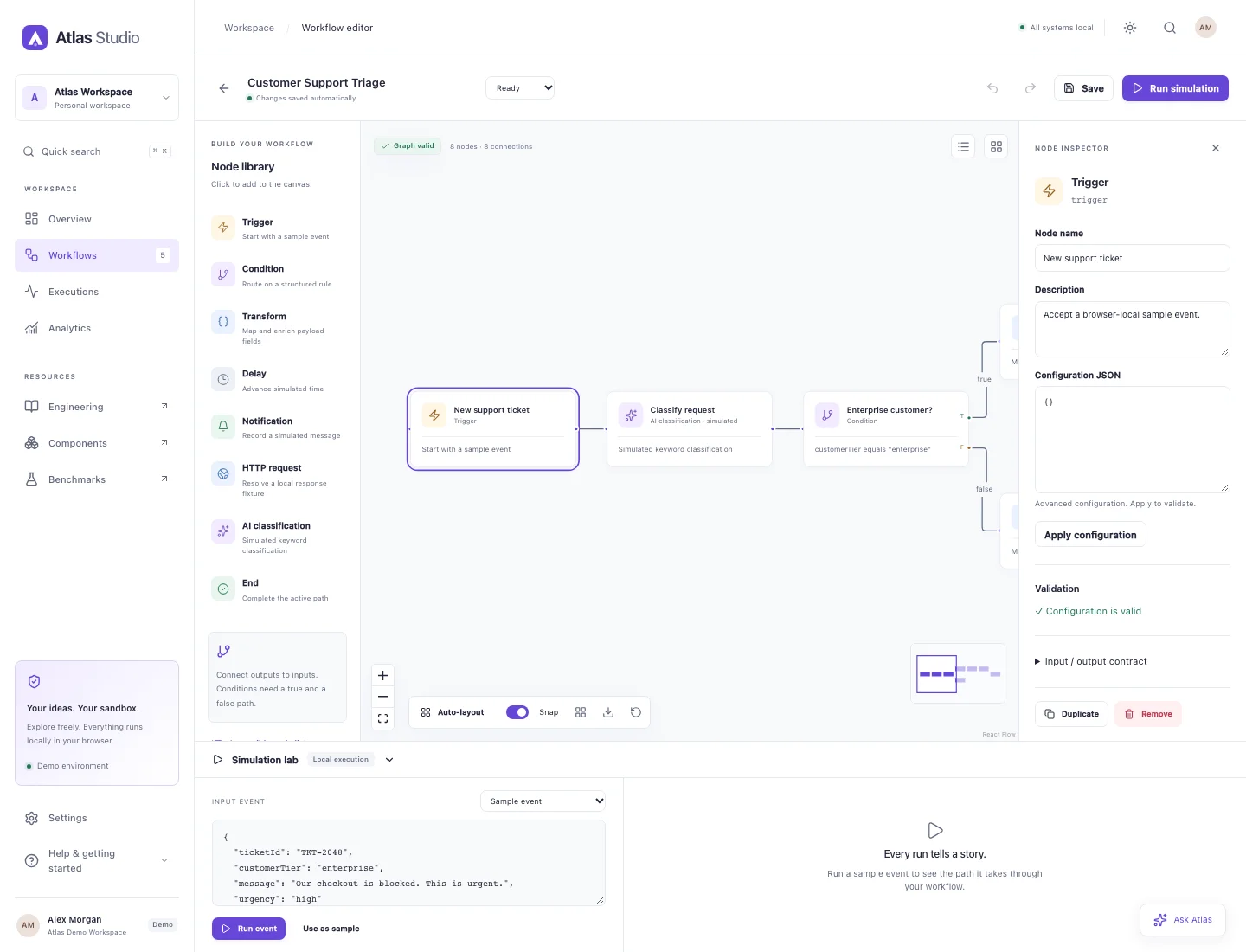
Design workflows visually, simulate events, and understand every execution. A browser-local studio that makes the logic visible.
What it does.
- Visual graph editor with eight node types
- Deterministic execution and step-by-step debugging
- Versioned local persistence and JSON import/export
- Shared accessible UI with an independent Storybook
The problem.
Workflow diagrams explain intent, but they rarely show what actually happens to a payload. Atlas connects the diagram to a deterministic execution so the same graph can be designed, run, and inspected.
The solution.
A visual workspace pairs a graph editor with sample inputs, explicit branch routing, structured execution logs, and a playback debugger. Five seeded workflows provide concrete starting points.
Product experience.
Create or duplicate a workflow, connect nodes, configure conditions and transformations, and validate the graph. Run a scenario, step through input and output at each node, then compare outcomes in execution history.
Engineering decisions.
The engine depends on typed contracts rather than React. Historical executions embed graph snapshots, while graph-edit undo remains separate from run history. Shared UI components are consumed by both the app and Storybook.
Challenges & trade-offs.
Keeping execution understandable means explicit boundaries: graphs are single-path DAGs, cycles are rejected, and delays use virtual time. HTTP, notifications, AI classification, and Copilot are simulations rather than live integrations.
Performance evidence.
The repository includes a reproducible engine benchmark at 10, 50, 100, and 250 nodes, with warm-up, median and p95 samples. Those CPU measurements do not establish canvas frame rates or field Web Vitals.
Clear boundaries.
Connected parts.
- 01Typed contracts
- 02React-free execution engine
- 03Graph editor & debugger
- 04IndexedDB workspace
The honest edges.
Browser-local state; no multi-user collaboration or cross-device sync. External requests and AI are explicitly simulated.
Capabilities are grounded in repository documentation and implementation. No adoption figures or performance improvements are inferred.